


Share
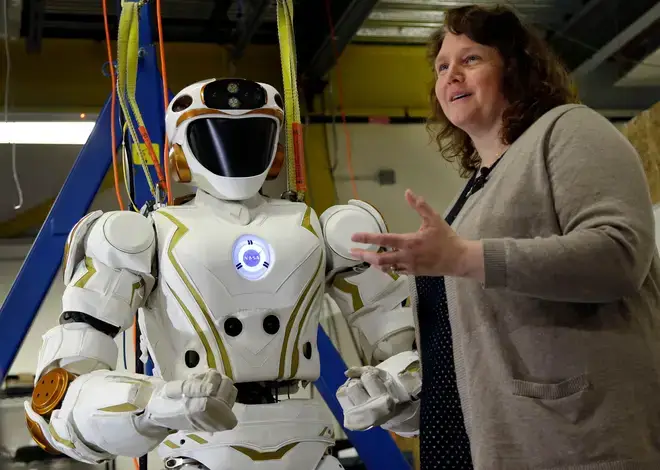
A humanoid Nasa robot being prepared for Mars will return to the US after a decade at a Scottish university.
The robot, named Valkyrie, is 1.8 metres tall, weighs 125kg, and is one of three prototypes in the world.
It was named after the Valkyries from Norse mythology, who were said to have led souls from Midgard (Earth) to Valhalla – the afterlife.
Valkyrie was one of the most advanced humanoid robots in the world when it arrived at the University of Edinburgh in 2016.
Nasa hopes to send the robot to Mars years ahead of astronauts landing on its surface.
Scientists at the university have spent the last decade improving Valkyrie’s handling and walking capabilities, honing its sensors to help it traverse the harsh Martian environment through data and new ways to connect what the robot sees, so it can move accordingly.
The research, by the university’s Centre for Robotics, is a joint initiative with Heriot-Watt University and involved dozens of PhD students.
It was supported by the Engineering Physical Sciences Research Council – a part of UK Research and Innovation.
Students and staff are now saying their goodbyes to Valkyrie as it is being returned to Nasa’s Johnson Space Centre in Texas.
The researchers will continue working with Nasa on other robotics projects going forward.
Vladimir Ivan, a former student at the university who worked on Valkyrie and is now chief technical officer at Edinburgh-based robotics start-up Touchlab, said: “Hosting Nasa Valkyrie at the University of Edinburgh was a rare privilege at a time when humanoid robots were not commercially available and only a handful of research prototypes existed worldwide.
“It gave us a unique opportunity to advance fundamental research in mobility and stability – work that has since evolved into humanoid systems we see in today – while helping to train and inspire a generation of outstanding roboticists.
“Valkyrie’s presence also helped catalyse Edinburgh’s evolution into a vibrant robotics hub, known for world-class research, thought leadership, and a thriving environment to grow knowledge, ideas, and robotics businesses.”
Professor Sethu Vijayakumar, personal chairman in robotics and director of the Edinburgh Centre for Robotics at the university, added: “It was a gamble to invest so heavily in humanoids research back in the 2010s, when the scalability of the adaptive learning-based methods for robot planning and control we were advocating was not obvious.
“In hindsight, this bold decision has contributed to the exciting wave of data-driven humanoid robot research that is now taken for granted.
“Valkyrie was indeed a trendsetter, benefiting from world-leading hardware from Nasa.
“We will miss her, but it has been a privilege. Thank-you for all the fun, Valkyrie.”