

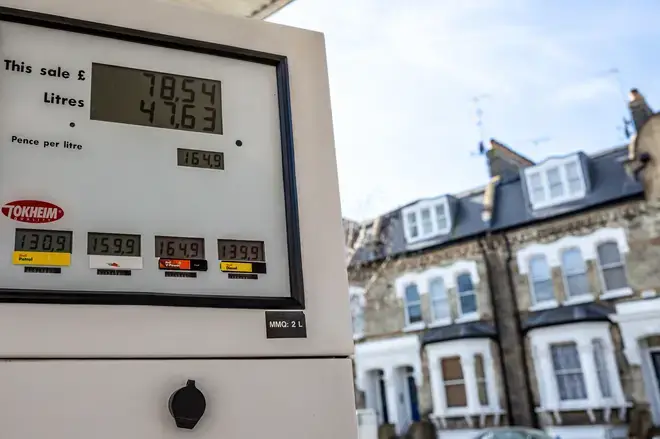

Ben Fletcher, CEO of Logistics UK, told LBC's James Hanson that Rachel Reeves must stop the rise due to take effect in September.
Share
The Chancellor should pause a hike to fuel duty to protect Brits from a huge spike in energy costs caused by chaos in the Middle East, an industry chief says.
Ben Fletcher, CEO of Logistics UK, told LBC's James Hanson that Rachel Reeves must stop the rise which is due to take effect in September.
His call follows the fears that Britain is about to see a significant rise in petrol prices after Iran closed the key Strait of Hormuz on Sunday after US-Israeli strikes killed the nation's Supreme Leader Ali Khamenei.
He said: "The Chancellor is due to raise fuel duty in September to reverse the 5 per cent cut that was introduced in the aftermath of the invasion of Ukraine by Russia.

"What we're saying is that at this moment it would be sensible to pause that decision, because that increase will immediately start to impact on the prices charged by hauliers in the UK, and that will filter through very, very quickly to the consumer."
Reeves is due to give the Spring Statement on Tuesday, but has said that no tax or spend plans will be announced in the fiscal event.
James asked Ben whether it would be prudent to instead take steps to bring down the cost of industrial energy in Britain.
Ben replied: "I think that high industrial energy prices have been a very big issue for a while, and certainly, I think many business groups, ourselves included, have asked the Government to think about measures that they can take to bring that wider price down.
"I think the particular issue at the moment on fuel duty is that it is something that's experienced a very sharp and stark spike in the last few days. And very importantly, there is a mechanism that Government can take straight away, which is to reverse a decision.
"We understand the rationale behind it. We don't support it, but we understand the rationale behind it. But given that the context has changed, we think that the Government response should change as well."
On Sunday, three vessels near the Strait of Hormuz, the narrow opening of the Persian Gulf which acts as a vital shipping route for the global oil trade, were struck by an "unknown projectile," according to the UK Maritime Trade Organisation (UKMTO).
At least 150 tankers dropped anchor in the open Gulf waters beyond the strait on Sunday, suggesting significant disruption.
Jorge Leon, senior vice president and head of geopolitical analysis at energy intelligence firm Rystad Energy, said that if the strait were blocked, the resulting spike in oil prices could directly impact consumers in the UK.
The Strait of Hormuz sees between 15 million barrels of crude oil pass through its waters each day, amounting to around a third of the global crude trade, Mr Leon said.
Qatar, on the Persian Gulf, is one of the world’s biggest exporters of liquified natural gas, and closing the strait could also impact these shipments, he added.
Disruptions in the liquid natural gas markets could drive up gas prices, which Mr Leon said were closely linked to the price of electricity.
Mr Leon said: "A higher electricity price will feed through the global economy, and, in particular in the UK, (lead to) higher inflation.
"We have a direct effect which is higher prices at the pump and higher electricity bills, but also a secondary effect, which is things will get more expensive because inflation might increase."
Mr Leon said that this outcome would only materialise if there was no de-escalation of conflict in the region, and the disruption was lasting.
The actions of the Iranian government over the coming days would have a "massive impact" on this, he said, adding: "The initial signals that we are seeing is that they are taking quite a hawkish approach at the moment.
"They keep attacking the rest of the GCC (Gulf Cooperation Council) countries, so we don’t think (de-escalation) will happen, or, at least, it’s not happening now."
Even if Iran shows signs of de-escalation, it could take a few weeks for shipping to return to normal as traffic clears and operators remain hesitant to use the strait, he said.
But John Stawpert, principal director marine at the International Chamber of Shipping, the global trade association for shipowners and operators, said this was not the industry’s "first rodeo," and believed it would adapt to challenges in the region.