

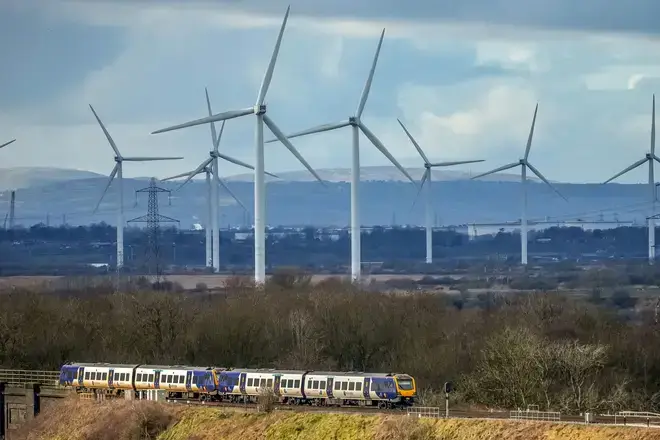

The Energy Secretary also told MPs he wanted to diversify supply chains as the UK builds out increasing amounts of solar panels and wind turbines
Share
The UK needs to be “vigilant” over security risks China poses to energy supplies, Ed Miliband has said.
The Energy Secretary also told MPs he wanted to diversify supply chains as the UK builds out increasing amounts of solar panels and wind turbines.
Appearing at the Energy Security and Net Zero parliamentary committee on Wednesday, Mr Miliband insisted that it was “compatible” to cut energy bills and build the new energy infrastructure the country needs.
And he hit back at claims over the costs of “subsidising” solar power, saying it was the cheapest electricity source the UK had.

In an exchange with Conservative MP Bradley Thomas, Mr Miliband was repeatedly asked why he had not published the details of a clean energy deal signed with China last year, replying that he was following the practice of the previous government.
But he acknowledged the need to be vigilant over investments in energy infrastructure by China.
“It’s absolutely right that we are vigilant about investments from China, particularly in relation to energy.
“That’s why while the previous government believed it was right for China to own our nuclear power stations.
“We believe that we need UK ownership of our nuclear power stations.
“That’s the decision we made in relation to Sizewell C.
“We need to be vigilant in relation to all states, and I include China particularly in that, in relation to the control of our energy infrastructure.
“Of course there are security risks in relation to China that we have got to be vigilant about.
“That’s why we’ve got to be very cautious about our energy system.”
Mr Miliband was also quizzed by Tory MP Sir Christopher Chope about the reliance on Chinese solar panels, and said the Government was working on developing domestic supply chains for clean technologies.
But he said that imposing requirements for British-made solar panels, in the absence of a domestic industry, would push up bills.
“We saw record solar installation last year.
“That is helping to cut bills for families across Britain, we are in a cost-of-living crisis and it’s incredibly important to do everything we can to cut bills for families.”
He added: “We need to find ways of diversifying our supply chain, but it’s going to take time because of the inheritance we have had, because the last government was completely asleep at the wheel.”
Challenged about the cost of subsidies for solar power, Mr Miliband told Sir Christopher he was “100% dead wrong in saying we are subsidising solar, because it’s the cheapest power source we have”.
He pointed to the results of the renewable power auction published on Tuesday, which secured solar schemes with an agreed price for electricity generated of £65 per megawatt hour, compared to analysis which shows the cost of building and operating new gas plants of £147 per megawatt hour.
Mr Miliband was also asked by Liberal Democrat MP Wera Hobhouse if the Government should be more honest with the public about the “upfront costs” of the energy transition, though bills will be lower in the future.
“Truthfully, we’ve got two things going on, in order to get away from the rollercoaster of fossil fuels we’ve been on, the right thing to do is clean power which can cut bills,” he said.
“But at the same time we’ve got a network infrastructure we’ve got to build because of the backlog we face and rising electricity demand.
“We are confident it is compatible to both cut bills and build the network infrastructure we need,” he said, adding that measures such as the Chancellor’s decision to move older renewable subsidies into taxation as part of efforts to cut bills by £150 on average made that possible.
