


Share
There is no automatic breach of female prisoners' human rights by the presence of men who identify as women, in the female prison estate, a Scottish human rights body has told a court.
A lawyer for the Scottish Human Rights Commission (SHRC) said that much depends on the "particular circumstances" of each case.
However he also told the court that the Scottish Prison Service's (SPS) trangender policy was flawed in that it did not consider the women's human right's at all.
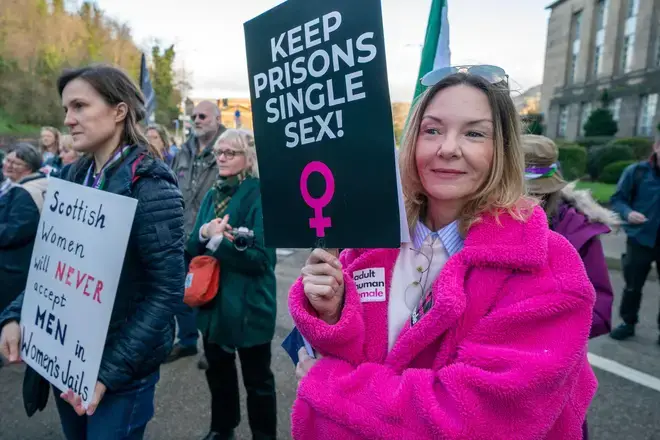
The campaign group For Women Scotland (FWS) is challenging the current SPS policy of holding some transwomen – biological men who identify as women – in the female prison estate.
The petition for a judicial review of the policy is being heard at the Court of Session in Edinburgh, as the group, who won a Supreme Court case in April last year, with judges at the UK's highest court making clear that the term "woman" in the Equality Act refers to a biological woman, believe the SPS policy breaches that ruling as prisons are single sex spaces.
The Scottish Government has argued a "blanket rule" stating that a "transgender prisoner can only be placed in the prison according to their biological sex would violate the rights of some prisoners.
Today, Kenny McBrearty KC spoke on behalf of the Scottish Human Rights Commission (SHRC), which has intervened in the case.
He stressed the independence of the SHRC and said it was not "in the pocket" of either FWS or the government and that its submission was not "ideological".
Mr McBrearty aid that according to human rights law there is no "positive obligation" to place trans prisoners in either part of the prison estate.
He said: "I would resist the notion that there is a positive obligation to place all trans prisoners within the estate that conforms with their biological sex – having regard to the article eight rights of women prisoners."
He said the suggestion that the "mere presence" of a transwoman on the female estate "automatically represents an unlawful interference with female prisoners' convention rights should be rejected".
The KC added: "The simple point is that a great deal may depend on the particular circumstances…
"In my submission, it is going a very long way to say there will be a breach of Article 8 [of the Human Rights Act] which will arise simply from the presence of any trans prisoner."
The court also heard from the Equality and Human Rights Commission which said it understood the rationale of the SHRC submissions, but "respectfully" disagreed.
Janys Scott KC argued the placing of any biological man in a women's prison automatically rendered that prison to be mixed, rather than single, sex.
She told the court that while it was possible to put men women and trans people in the same prison they had to remain "segregated" and the Supreme Court ruling had clarified that situation.
Earlier Tony Convery, advocate for FWS, discussed the current SPS guidance document on the management of transgender prisoners.
He said it was "materially misdirecting" SPS staff, adding: "They are led to believe that sometimes biological men can be accommodated in the estate for biological women…
"For the reasons we set out yesterday, we believe this is unlawful."
