


Thwaites Glacier in Antarctica is known as the 'Doomsday Glacier' because if it collapses, it will cause global sea levels to rise by over a metre.
Share
Scientists from the British Antarctic Survey (BAS) are to drill into the most fragile part of Antarctica's Doomsday Glacier to study how warm ocean water is melting it from below.
Researchers from the UK and South Korea are about to drill into the most inaccessible and least understood part of Thwaites Glacier, in West Antarctica.
Measuring around the size of Great Britain or the US state of Florida, the mass of ice is one of the largest and fastest-changing glaciers in the world.
Known as the 'Doomsday Glacier,' with ice up to 2,000 metres thick in places, global sea levels would rise by 65cm if it collapses.

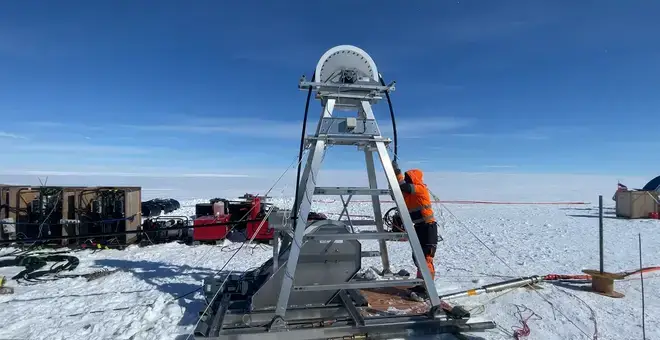
Over the next two weeks, researchers from the British Antarctic Survey (BAS) will use a hot water drill to bore through the ice and use instruments that will send back the first real-time data from this critical location.
It's hoped this will enable them to better understand how warm ocean water is melting the glacier from below.
“This is one of the most important and unstable glaciers on the planet, and we are finally able to see what is happening where it matters most," said Dr Peter Davis, a physical oceanographer at BAS.
The International Thwaites Glacier Collaboration team, led by the UK and US, has been studying more stable parts of the glacier since 2018.
The team will drill 1000 metres through the ice, just downstream of the grounding line, the point where the glacier lifts off the seabed to become a floating ice shelf.
This is Thwaites’ most vulnerable point, where the warmest ocean water flows under the glacier and melts it from below.
Until now, the main trunk of Thwaites has remained largely unexplored due to its crevassed and dynamic nature.
“This is polar science in the extreme," said Dr Won Sang Lee, leader of the expedition from the Korea Polar Research Institute (KOPRI).
"We made this epic journey with no guarantee we’d even be able to make it onto the ice, so to be on the glacier and getting ready to deploy these instruments is testament to the skills and expertise of everyone involved from KOPRI and BAS.”
Millions of people in the UK live in coastal communities, and rising seas threaten cities, infrastructure, and livelihoods around the world.
Understanding how Thwaites Glacier behaves could prove critical for predicting and preventing future sea level rises, and give governments and communities more time to plan and adapt.