

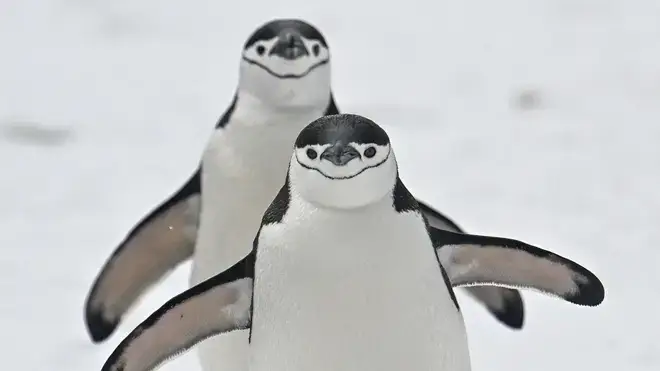

The biggest change was for gentoo penguins, whose breeding season shifted by 13 days on average.
Share
Antarctic penguins are breeding up to two weeks earlier as a result of climate change, a decade-long study has found.
Researchers studying Adelie, gentoo and chinstrap penguins said the changes were happening at a “record” rate, and warned they could threaten the birds’ access to food, force competition between species, and increase the risk of “broad ecosystem collapse” in the Antarctic.
Researchers used dozens of time lapse cameras across 37 colonies in the Antarctic Peninsula and some sub-Antarctic islands to see when Adelie, gentoo and chinstrap penguins were settling into their breeding sites.
The team from the University of Oxford and Oxford Brookes University monitored the penguin colonies over 10 years from 2012 to 2022, as the Antarctic Peninsula was warming dramatically, as well as recording environmental factors such as temperature.
They found the average date when the penguins, which nest on snow-free ground in colonies of between a dozen and hundreds of thousands of nests, were fully occupying their breeding sites moved forward at record rates.
The biggest change was for gentoo penguins, whose breeding season shifted by 13 days on average, and up to 24 days in some colonies, while Adelie and chinstrap penguins started breeding around 10 days earlier on average.
The scientists said the advance in breeding by gentoos was a record for change in phenology recorded in any bird, and possibly any vertebrate animal, to date.
Phenology is the timing of seasonal events, such as birds breeding, and takes place as a result of varying cues such as day length, temperature or food availability.
The researchers said the record shifts were happening in relation to changes in the environment including less winter sea ice, greater productivity of the oceans in creating organic matter that feeds food chains, and rising temperatures.
Camera temperature loggers showed the penguin colony locations are warming up at around 0.3C a year, four times more than the continental average of 0.07C, which is itself the second-fastest warming area in the world.
The scientists said it was not known whether the shift in when they breed is affecting breeding success or is part of each species’ adaptation to environmental changes.
But changes in breeding timing can lead to a mismatch between predators and their prey when trying to rear young, the scientists said, with the potential to affect success in producing young.
The penguins could also come into competition with each other for resources.
And it is unclear how much more the species will be able to shift their breeding times if temperatures keep rising at the current rate, they warned.
Lead author Dr Ignacio Juarez Martinez from the University of Oxford and Oxford Brookes University said: “Our results indicate that there will likely be ‘winners and losers of climate change’ for these penguin species.
“Specifically, the increasingly subpolar conditions of the Antarctic Peninsula likely favour generalists like gentoos at the expense of polar specialists like the krill-specialist Chinstraps and the ice-specialist Adélies.
And he said: “Penguins play a key role in Antarctic food chains, and losing penguin diversity increases the risk of broad ecosystem collapse.”
Co-author Dr Fiona Jones, from the University of Oxford, added: “As penguins are considered ‘a bellwether of climate change’, the results of this study have implications for species across the planet.
“Further monitoring is needed to understand whether this record advance in the breeding seasons of these penguin species is impacting their breeding success.”
The study was published in the Journal of Animal Ecology to mark Penguin Awareness Day on Tuesday.
